
Why Are We Paying Luxury Prices for Party City Fabric?
The quiet shift from natural fibers to plastic, and the illusion we’re still buying quality. The true price of polyester and how to know if you’re overpaying for it.

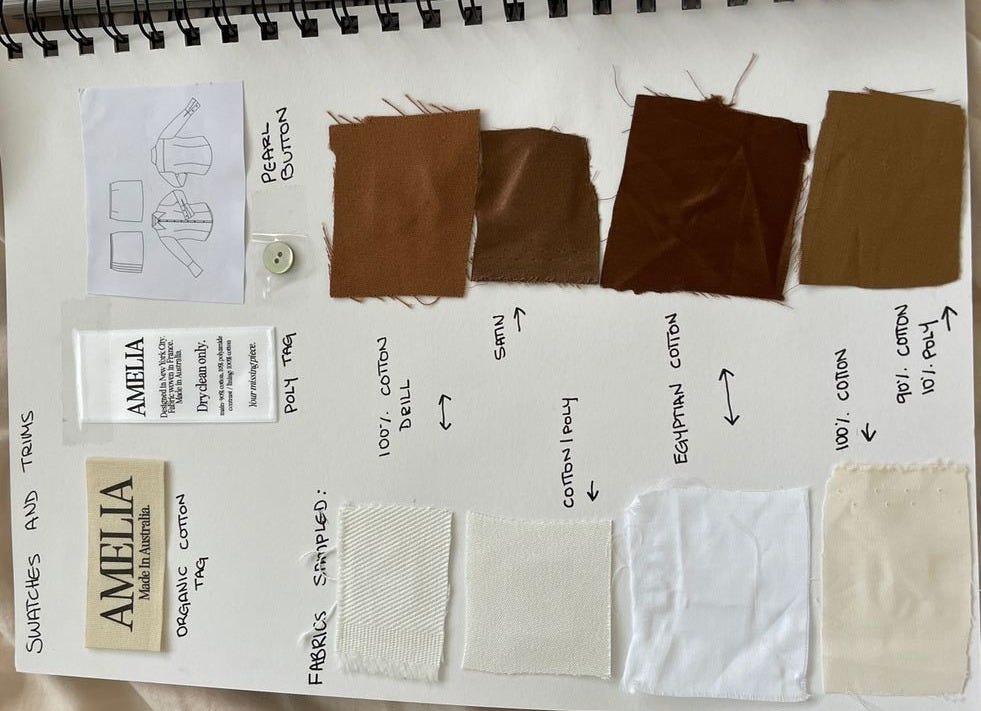
If you have felt that every piece of clothing you have purchased in the last year has felt adjacent to what used to pass as a Halloween costume, then you’re not alone. Most often, it is that same material. In the past 20 years, The fashion industry has mastered a quiet trick:
Make the fabric cheaper.
Make the garment thinner.
Raise the price anyway.
An 89 CAD top made of 92% polyester is quite common in 2026. Or a completely synthetic dress that costs $248 CAD. Or a $398 CAD blazer that is marketed as "elevated essentials" and is mainly composed of plastic fiber.
The existence of polyester is not the problem.
The problem is that although overall garment quality is declining, premium rates are being paid for one of the cheapest fibers used in global apparel production.
Let's examine what polyester is, how much it costs you, how much it costs brands, and how to recognize when you're overpaying.
What Polyester Actually Is (And How It’s Engineered)
Polyester is a synthetic polymer derived from petroleum. Most apparel polyester is made from polyethylene terephthalate (PET), the same base polymer used in plastic beverage bottles…
The engineering process:
Petroleum is refined into chemical compounds.
Those compounds are polymerized into long plastic chains.
The plastic is melted and extruded through spinnerets into filaments.
The filaments are woven or knit into fabric.
It is engineered for:
Durability
Shape retention
Wrinkle resistance
Scalability
Low cost
According to Textile Exchange, polyester represents over half of global fiber production today. However, unlike many things in the fashion industry, it’s dominance is not about luxury. It’s about production efficiency and economic margin.
Clothing Production Is Getting Worse — Prices Are Getting Higher
Over the last 15 years:
Global clothing production has doubled.
Garments are worn fewer times.
Fabric weights (GSM) have decreased.
Synthetic blend percentages have increased.
The Ellen MacArthur Foundation has reported that clothing utilization has declined significantly despite rising production.
Meanwhile, brands across all tiers, from Prada, to Aritzia, to Zara, have normalized polyester-heavy collections at steadily rising retail prices.
We are paying more, for less intrinsic material value, and being sold an illusion: Plastic, priced as prestige.
What makes this polyester shift uniquely modern is that it does not target one economic class, it flattens them.
Fabric composition used to be an obvious indicator of hierarchy: natural fibers denoted higher price tiers, while synthetics dominated mass retail. That distinction has diminished in the modern era. Polyester is no more limited to $29 shop shelves; it can be seen in both luxury homes and modern labels. At high-end stores like SSENSE and Net-a-Porter, you may find gowns that range from $400 to $900 and are mostly made of polyester or poly mixes.
Even classic names like Gucci, Prada, and Balenciaga frequently create ready-to-wear items at four-figure price tags using mixed fabrics, technical polyester, or synthetic crepe. Customers of all income levels are frequently purchasing the same underlying fiber, albeit at wildly disparate margins, creating an odd economic illusion. The gap is now mostly caused by branding, marketing language, silhouette, and perceived prestige rather than material factors. Although polyester is now distributed democratically, the markup is still hierarchical.
How to Know If You’re Overpaying (CAD$)
Below is a realistic low-to-mid retail benchmark in today’s Canadian market. If retail pricing significantly exceeds these ranges, pause.
Price Reality Chart (CAD$)
(Basic to mid-tier garments, non-designer.)
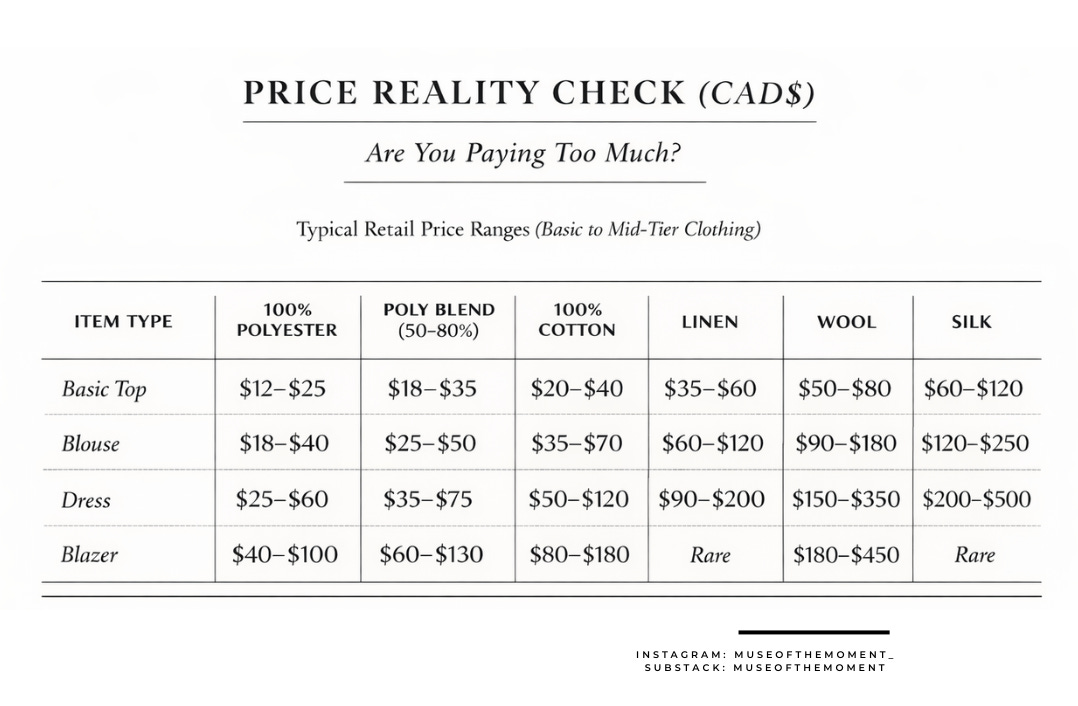
These ranges reflect material value logic.
If you are seeing:
A $95 polyester top
A $220 polyester dress
A $380 polyester-blend blazer
Then you are not paying for fiber cost, you are paying for brand narrative.
The Health Implications of Polyester
(Disclaimer: The following references publicly available research. Always consult a healthcare professional for medical concerns.)
Polyester’s impact isn’t only environmental. It also affects comfort, and potentially skin health.
1. Heat Retention & Breathability
Polyester has a hydrophobic nature. Instead of absorbing water, it repels it. Rather than being effectively absorbed and dissipated, sweat remains between the skin and the garment. Airflow is permitted and moisture is absorbed by natural fibers such as linen and cotton.
The cultural misunderstanding becomes intriguing at this point.
In the Gulf and across Southeast Asia, modest dressing is simply the norm. Yes — that often means full coverage, even in serious heat. But here’s the part people overlook: those garments are usually made from 100% cotton or linen. Airy. Breathable. Designed for the climate.
And yet, without fail, someone will ask:
“Aren’t you hot under all that?”
It sounds logical, more fabric must mean more heat. But here’s the science lesson we all could use: thermal comfort is driven less by surface area and more by fiber structure and moisture management. Cotton and linen are hydrophilic fibers, they absorb moisture from the skin and allow it to evaporate, creating a cooling effect through evaporative heat loss. Their woven structure also promotes airflow, which enhances convective cooling.
Surface area isn’t the issue. Fiber composition is.
You can wear less clothing and still be sweating buckets, if it’s synthetic.
2. Microplastic Shedding
A widely cited study published in Environmental Science & Technology (Browne et al., 2011) found that synthetic garments release microfibers during washing, contributing to marine microplastic pollution.
Polyester sheds plastic particles.
Cotton does not.
3. Skin Irritation & Bacterial Retention
Polyester can:
Trap sweat
Retain odor
Increase bacterial buildup
Exacerbate eczema or sensitive skin conditions in some individuals
Because it does not breathe like natural fibers, moisture and heat can accumulate at the skin surface.
4. Chemical Concerns
Catalysts like antimony compounds can be used in the production of polyester. Long-term health effects are still being studied. Although direct effects on human health are still being investigated, organizations such as the World Health Organization have recognized environmental problems with microplastics.
The Overpaying Checklist
Before you buy:
☐ Check composition percentage
☐ Compare fiber type to price
☐ Feel thickness (is it lightweight?)
☐ Check lining material
☐ Examine seam finishing
☐ Ask: would this price make sense without the logo?
If the answer is no, you’re paying for positioning.
The Bigger Picture
Retail prices have continued to climb, fiber quality has decreased, synthetic usage has increased, and clothing production has quickened. Polyester is an example of engineered efficiency; it is scalable, affordable, and profitable. Natural fabrics, density, craftsmanship, and longevity, on the other hand, have historically been the foundation of luxury. Modern fashion is defined by the conflict between those two realities.
In this economy, reading the tag is financial literacy.
Before you buy, know what you’re wearing , and what you’re paying for.
-
Subscribing to you based on this headline alone, because wtf?!
Saving this post for the next time I go shopping!! And even better in CAD!💸